UoN Office of Career Services (OCS)

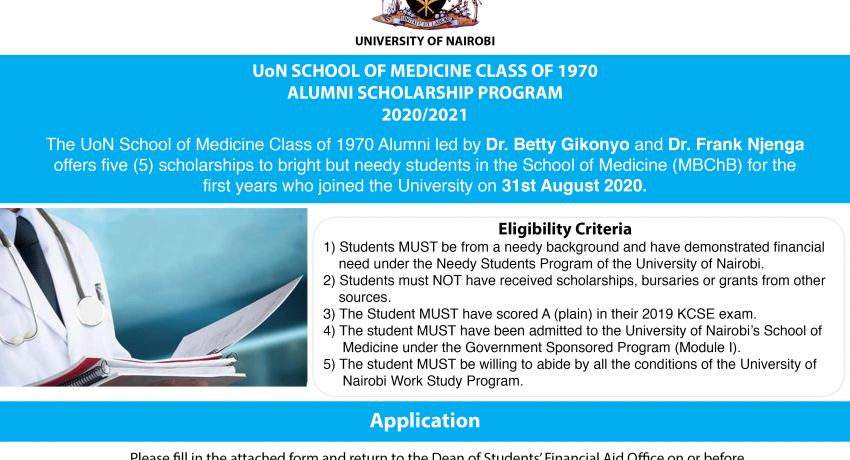
UoN SCHOOL OF MEDICINE CLASS OF 1970 – ALUMNI SCHOLARSHIP PROGRAM

UoN SCHOOL OF MEDICINE CLASS OF 1970

ALUMNI SCHOLARSHIP PROGRAM

2020/2021 

The UoN School of Medicine Class of 1970 Alumni led by Dr. Betty Gikonyo and Dr. Frank Njenga offers five (5) scholarships to bright but needy students in the School of Medicine (MBChB) for the first years who joined the University on 31st August 2020. 

Eligibility

1)    Students MUST be from a needy background and have demonstrated financial need under the Needy Students Program of the University of Nairobi

2)    Students must NOT have received scholarships, bursaries or grants from other sources

3)    The Student MUST have scored A (plain) in their 2019 KCSE exam

4)    The student MUST have been admitted to the University of Nairobi’s School of Medicine under the Government Sponsored Program (Module I)

5)    The student MUST be willing to abide by all the conditions of the University of Nairobi Work Study Program.


Application

Please fill in the attached form and return to the Dean of Students’ Financial Aid Office on or before 21st September 2020 via email: financial-aid@uonbi.ac.ke

Access Application Form

#UoN@50 years | #UoNCares


‘A World Class University Committed to Scholarly Excellence’

A Call for Christian Union of your Campus Registration!!

Dear First Year Christians,

Welcome to a World Class University committed to scholarly excellence!

The Chaplaincy of the University of Nairobi congratulates you for making it to the University. 

 
The Chaplain would like you to be nurtured in your Christian Faith as a student in the University. The University provides a platform in every campus for the holistic growth of every student in the Christian Union.

If you would like to join the community kindly click on the link below.

Application Form: https://forms.gle/HJoiFeiRqjYWavcEA

The Chaplain will be glad to provide a community to keep in touch with during this Covid-19 period. 

A Call for Catholic Students Community Campus Registration!!

Dear First Year Catholic Student,

Welcome to a World Class University committed to scholarly excellence!

The Catholic Chaplaincy of the University of Nairobi congratulates you for making it to the University.

The Chaplaincy would like you to be nurtured in your Christian Faith as a student in the University. The University provides a platform in every campus for the holistic growth of every student in the Catholic Students Community.

If you would like to join the Catholic Student community at UoN, kindly click on the link below.

Application Form: https://docs.google.com/forms/d/e/1FAIpQLSfaPjjNOpcBUZZZTthJ977y69egTJdeNgkyJLFRoVdNvj7FRg/viewform?usp=pp_url

The Catholic Chaplain will be glad to provide a community to keep in touch with during this Covid-19 period.

The Hult Prize Program launched at the University of Nairobi

On Friday September 4, 2020, the Vice Chancellor Prof. Stephen Kiama launched the Hult Prize program at the University of Nairobi.

The University of Nairobi has in many decades celebrated innovation and entrepreneurial skills among its stakeholders including students who have continuously competed on the global arena and emerged winners.

The spirit of the Hult prize is to give the students, both undergraduate and postgraduate an opportunity to hone their innovation skills and to be part of a social movement that seeks to address the most pressing issues of the 21century.

The Hult prize has in the recent past focused in offering solutions in the areas of Education, Clean Water, Energy, Poverty, Global Food Crisis, Healthcare, Early Childhood Education, Doubling Income, Refugee Crisis, Harnessing the Power of Energy and Youth Unemployment and Climate Change.

The UoN Hult Prize on-campus program is an opportunity for the students both undergraduate and postgraduate to hone their innovation and creativity skills to address the most pressing challenges of the 21st Century. For the year 2020, the theme of the program is focusing on Food, “transforming food into a vehicle for change”, The reality of the world we are living in is a population that cannot feed itself.

This year like many other years, students from and across the globe will be competing for a seed capital of USD 1,000,000. The University of Nairobi students will participate in this competition and we believe that our students have the capability to bag this award.

This program fits very well in the recently launched five 5-point reform agenda by the Vice Chancellor aimed at transforming the University into “A vibrant and Sustainable University” a university benefiting society through research and innovation. This Hult Prize Social Innovation Challenge aligns very well with the VC’s Reform Agenda Number 5 on people where  the University will identify and celebrate talents and achievements, exploit intangible assets through commercialization and to promote research and technology transfer ecosystem, ensure the University attracts, recruits, supports and retains outstanding staff and students and provide a diverse, inclusive, fair and open work environment where people give their best to their work and feel valued.

As many students as possible are invited to participate in the challenge as possible and lecturers will mentor the students who seek mentorship to develop their entrepreneurial skills.

The Vice Chancellor and the Dean of Students wishes the organizing committee led by a UoN Alumnus, Mr. John Mwati, the Campus Director a very successful on campus program.


VC welcomes over 10,000 new students for the September 2020 intake

The University of Nairobi has welcomed over 10,000 new students for the Academic Year 2020/21.
The new students have been admitted to the six UoN Colleges and the ODeL Campus. This admission process is an important milestone in the history of the University of Nairobi as it is the first time that the institution has conducted end to end academic processes using online platforms.
In the Vice-Chancellor’s virtual address to the new students, Prof. Stephen Kiama welcomed them and gave them wholesome advice that will help them steer their way through university life.
Prof. Kiama congratulated  all admitted students for their hard work that propelled them to be admitted into the prestigious University. “This signals the assurance of continuity of the University. You have now become members of UoN family and we are happy that you have chosen to join us” reiterated Prof. Kiama.
The Vice Chancellor in his speech emphasised on the application of technology in solving problems and in communication as one of the critical skills for the future that every graduate from the University of Nairobi must acquire for work and for personal survival in this digital era. It is therefore extremely critical that every student is equipped with either a lap top or a tablet to enable them access online classes and learning resources.
The Virtual VC address to first year students  marked a very important milestone in the history of UoN. It is the first time that UoN has conducted end to end academic processes using online platforms. By putting systems in place, the University processed admissions online, registered students online and now students are going to be taught online for their Semester.
The Vice Chancellor’s freshmen address is always a very important ceremony for the University. It is part of the freshmen orientation where new students are welcomed to the University community. In order to give the time to settle down and adjust to life at the University of Nairobi, a week of orientation has been set aside. The students are introduced to various aspects that form part of their lifestyle for the period of stay at the university.

18 UoN Students awarded an Advanced Agriculture Diploma from AICAT to extend their training until October 2020

Following the Jerusalem Declaration, an MoU signed between President Uhuru Kenyatta of Kenya and H.E. Benjamin Netanyahu, Prime Minister of the State of Israel signed on 23rd February 2016,   the University of Nairobi among other Agricultural, Water and Irrigation Training related institutions sent top students to the Arava International Centre for Agricultural Training (AICAT) to study an Advanced Diploma in Agriculture and Agribusiness.

Eighteen students from the University of Nairobi’s Faculty of Agriculture were among the 120 students flagged off by the former Cabinet Secretary for Water and Irrigation, Hon. Eugene Wamalwa on July 21, 2017, for an 11-month advanced agriculture & irrigation training in Israel.

The eighteen students started their training on 1st August 2018 for an 11 months program on Advanced Agriculture and Irrigation at Arava International Centre for Agricultural Training (AICAT) in Israel where they were attached to work with farmers in Kibbutz and Moshav Jewish forms of settlement. The students lived in farms in the Arava region where and were exposed to the high technologies and the advanced agriculture in Israel. The students should have completed their training by June 30, 202, however, owing to the Covid-19 pandemic and restrictions and ban on travel, their program was extended to October 2020.

The program has impacted on the graduates’ life in different aspects including socially, academically, and economically. The students have gained leadership skills and can now become community leaders and agricultural mentors; they have both practical and theoretical tools in food safety and security and knowledge on how to successfully establish agribusinesses and model farms. When they return home, the graduates will easily integrate professionally in both the public and private sector.

The next batch of students for the 2020/2021 cohort will leave for Israel once it is determined on when is the most suitable timing. The University is proud to partner with AICAT in this hands-on training initiative in Agriculture and Agribusiness.

Huawei Graduate Trainee Program Success Story

Dennis Kamindu is a University of Nairobi alumnus. He studied BSc. Electrical and Information Engineering and graduated in September 2018 with a Second Class Upper division. While in Campus, Dennis was involved in various activities, but the most significant was at ‘The Journey UoN’ where he was a member of the band. Here is where he nurtured my guitar skills, improved my social skills, and formed friendship bonds that have lasted till today.

Dennis joined Huawei through a graduate management trainee recruitment drive that was held at the University of Nairobi in June 2018. At that moment, we were doing our final year projects. He applied for a position at the company and they responded by inviting me for an interview.

There were about 87 of us at the interview stage. The interview itself was held in three separate levels (Group interview, Technical interview & Final interview), on the same day and at each level, some of us got eliminated. A few weeks later, he got mail that he had successfully passed the interview stage and was offered one of the positions available.

The graduate management trainee program itself was quite unique. The first month was an in-class training, done and facilitated by a vast team of experts in their various fields. After each course, we did an exam to measure our understanding of the various courses. After the first month, depending on the score obtained from the exams, you were placed in the specific department in which you preferred and scored the highest. This was followed by a 4 month on job training experience. During this period, Dennis was assigned a mentor that guided me and supported me through the whole journey. The mentors assigned to all the trainees were experts with many years of experience in their respective fields.

At the end of the 4 months of on job training, there was an appraisal done based on the tasks handled. The appraisals were very objective, because these were based on results and also how much you were able to learn under your mentor. Therefore, it was very important to learn as much as possible from your mentor because during the final oral defense held in front of a panel of experts, a lot of questions would be asked based on you work experience.

After the 4 month on job training, Dennis was named one of the excellent staff and offered a position in the company. He now works for the IT Solution Sales Department in a very diverse team of experts who have given me so much support in growing my career as well as in understanding the IT product portfolio.

Dennis’s transition from campus to the Huawei workforce has been made seamless due to the hard work of a dedicated team of experts that came together to formulate a unique management trainee program that seeks to develop knowledge, social skills, communication skills and work ethics while maintaining all the unique aspects of the individual intact.

Huawei provides a very conducive environment to achieve a work life balance. For instance, there is a floor in the building dedicated for recreational purposes where employees can play indoor games. This facility also has gym equipment for physical health. Huawei also provides a platform for showcasing talent. For example in sports, we have had various tournaments in football and basketball. In other areas for example music and culture, Huawei provides platform to showcase dance, music and cultural talents. Dennis has been offered many opportunities to showcase my musical talent in various Huawei events and gatherings.

Overall, his experience in Huawei has been one of learning, multi-cultural inclusion and support for personal and career growth.

Students’ Welfare on campus: Key to Achieving Academic Excellence

The University of Nairobi is committed to creating an environment that enables student to focus on their learning but also to realize their full potential and grow holistically (academically, socially, mentally and physically). As the University promotes this holistic development of students, there arose a need for a policy and guidelines to regulate the conduct of students while carrying out their activities on campus. This led to the revision of the Students Code of Conduct 2020 to guide students in their behavior and responsibilities as they go about their day to day activities engaging with fellow students and the wider University community. The Students Code of Conduct also enables students to express themselves freely and appreciate that their responsibilities and rights are being respected.

The aim is to produce holistic students who are responsible, honest, accountable and productive once they transit from learning to the job/entrepreneurship market and to society as a whole. This will in return foster a positive image for the University of Nairobi. Overall, the Students Code of Conduct aims to promote a conducive working environment within the University Community where everyone can learn, work and live together in peace and harmony.


Impact of Covid-19 on Education and Students’ Life

The Covid-19 pandemic has affected the state of University Education in the country necessitating the need for measures to be put in place to address the challenges brought about by the new norm.

After the Cabinet Secretary for Education Prof. George Magoha ordered for the closure of the University owing to the Covid 19 pandemic, the University of Nairobi closed for two weeks to plan on how to ensure continuity of learning after which staff and students were trained on how to move to remote/online teaching and learning.

The current state of teaching and learning at the University as far as the Covid 19 pandemic is concerned is good, and great strides have been made with more postgraduate and undergraduate students coming on board and embracing the new norm.

The online teaching and learning has had its own share of challenges in terms of access, accessibility and ease of learning. Being a new innovation different from the usual norm, there have been early innovators, early adapters, late adapters and the laggards at the end.  The University listened to all issues raised by both staff and students and addressed them in the planning of the online lectures.

Some of the measure the University took to address the challenges raised on online teaching and learning include providing data bundles for both lecturers and students, training lecturers and students on the new mode of learning, training to non-teaching staff on platforms to use and work online. To a large extent, there is successful business continuity in the university operations.

The Corona pandemic brings about the need to infuse ICT in teacher training online platforms more strongly. Covid-19 has clearly brought an awakening for the Country and University that there is need to invest in technology and increase access to data and internet and make it cheaper for the students to access teaching and learning. He thanked the government for the Google loon and Telkom partnership to increase access to internet. The 4th industrial revolution is here with us and access to affordable internet and data is vital to realize these technological advancements.


Vice-Chancellor’s Reforms Agenda 2020

Vice-Chancellor’s Reforms Agenda: University of Nairobi
August 28, 2020
To
The University Community,
Stakeholders and Partners
Ladies and Gentlemen,
During my address last week on Friday, I indicated that I will be sharing my reform agenda with the University community in a week’s time.
You recall that when I assumed the office of the Vice Chancellor, I promised to provide leadership and initiate reforms that will make our University great through relevance and impact. My short experience in the office has accorded me the insights into the areas that need urgent reforms to unlock more potential for growth and sustainability.
We are at a critical stage where change in the way we conduct our business is inevitable.
I therefore wish to outline my five 5 point reform agenda aimed at transforming the University into
“A vibrant and Sustainable University”
A university Benefiting society: Providing highest quality learning and teaching for students: Leading in research and innovation: Attracting, growing, supporting and recognizing talent among students and staff.
To inspire and achieve these aspirations, there is need to Institute reforms at University of Nairobi that advance the University onto the trajectory to excellence and to foster an entrepreneurial culture.
However, as we carry out these reforms, we shall not loose sight that the University of Nairobi is a strategic public entity. Consequently, we shall institute measures to engage the Government as the sponsor of public education in Kenya, to deliberately channel more resources into our university to ensure we continue carrying out those mandates that are of common good to the Kenyan people.
My reform agenda will be guided by the following five principals and philosophy of the University of Nairobi.
The Principles
        •       Alignment to the core mandate of the University
        •       Efficiency and accountability
        •       Impact
        •       Sustainability
        •       Value for money
The Philosophy
The University is guided by the Philosophy for the need to inspire and connect with the Kenyan community, to provide leadership and stewardship and to give hope and faith to the Kenyan society that it can excel in whatever it chooses to do with passion, moral responsibility and a strong sense of patriotism.
The Outcomes
The expected outcome of these reforms is to make the University of Nairobi:
        •       The destination of choice for outstanding local and international students, scholars, innovators and industry,
        •       The preferred knowledge partner for governments on ideas, solutions, critique and policy directions,
        •       The trusted resource in thought leadership, public engagement with research and teaching, and impact on the society culturally, socially and economically.
Focus of the Reforms
My five point reform agenda have been selected on the basis of fulfilling the five guiding principles:
Agenda Number 1: Data-driven management
In 2016, our Chancellor recommended a visitation of the university. The Visitation Panel observed that one of the constraints impeding institutional planning and efficient management of the University was the absence of a coordinated university-wide data management and access system.
We therefore shall invest our energies and resources towards setting up a comprehensive and integrated data management system. This will entail reengineering our business processes and embedding the use of technology in:
        •       Curriculum content delivery
        •       Human resource management
        •       Financial and research grants management
•       Student management including the administration of exams and timetabling.
The use of data will revolutionize how decisions are made, optimize deployment of resources and improve overall systemic output. Use of data in decision for better decisions: leveraging on verifiable data to lower decision turnaround time, to seize time-sensitive opportunities, to make better predictions and to improve planning and implementation of projects and programs
Agenda number 2- Governance
University has over the years grown in size and complexity. To stay in step with the needs of the university, I believe that there is compelling need to refresh our management, administrative, oversight and governance structures. This will entail:
        •       Identification and elimination of redundant and overlapping systems, processes, structures and reporting centers
        •       Creating an In-build effective flow of power, resources, responsibility and accountability to the lowest levels
        •       Institutionalization of efficient decision, policy making and implementation at every level
Agenda number 3- Curricula
 Embark on the path of fit-for-purpose training.
To do this, we will:
        •       Review of the courses offered at the University
        •       Assess the overall cost of implementation of each program and the level to which they respond to market, industry, societal and government needs
        •       Weed out redundant and overlapping courses and programs
        •       Review fee structure to ensure sustainability of those that remain
Additionally, we will:
        •       Interrogate the depth of substance coverage in the delivery of curricula, and inculcation of appropriate practical skills
        •       Integrate industry in the teaching and research at the University
        •       Review our research exploits to encourage vertical progression in pursuit of new knowledge, standardize and laterally integrate our curricula and integrate entrepreneurial spirit and culture throughout our programs.
        •       Recalibrate our metrics of world class-talent and to make deliberate efforts in growing the internationalization of the University.
Agenda number 4-  The financial reforms.
        •       Currently, the University is operating under a huge financial deficit. This impedes its path to world-class status.  Consequently, these reforms are geared towards institutionalizing prudent financial management and controls to put the University back on to a positive financial health and path to sustainability.
Specifically, this reform agenda will address:
        •      Efficient and participatory budget formulation mechanisms, fiscal and budgetary discipline
        •       Efficient payment and banking services
        •       Systems to stop revenue leakage, wastage, and optimize utilization of resources
        •       Review of the financial viability of income generating units
        •       Re-engineer grants management to effectively support research
        •       Reform of procurement functions to maximize efficiency, increase transparency and accountability and deliver value for money.
An efficient and optimal internal financial ecosystem will allow the university to move with confidence towards scaling external resource mobilization with a high level of confidence that any cent received will render 100% value for money and eliminate the financial deficit.
Agenda number 5-  People
The University students, faculty and staff are the foundation of the success of the University in benefiting the society, ensuring highest quality of learning, teaching and research. The university will proactively take deliberate steps to brand it self and to add value to its staff and students. This reform agenda aims to:
        •       Identify and celebrate talents and achievements,
        •       Exploit intangible assets through commercialization and to promote research and technology transfer ecosystem
        •       Ensure the University attracts, recruits, supports and retains outstanding staff and students
        •       Provide a diverse, inclusive, fair and open work environment where people give their best to their work and feel valued.
Ladies and Gentlemen,
I want to acknowledge that the reform path is not always smooth. We will have to overcome many obstacles but I am confident that with your support, commitment and endurance, we shall reach there.
Thank you and God bless you.
PROF.STEPHEN KIAMA GITAHI, PhD
VICE CHANCELLOR