

UoN Office of Career Services (OCS)

Symbols of authority handed over to the 8th UoN VC

During his installation ceremony on June 5, 2020, Prof. Stephen Kiama, the 8th UoN VC received the following symbols of authority from the Chancellor, Dr. Vijoo Rattansi.

  1. Constitution of Kenya 2010
  2. University’s Act No 42 of 2012
  3. UoN charter 2013
  4. Code of conduct & ethics for public universities 2009
  5. University Standards and Guidelines 2014
  6. UoN statutes
  7. Fountain of Knowledge
  8. UoN Seal
  9. UoN Logo
  10. UoN Mace
  11. Custody of Records.

The significance of each of the symbols is explained below.

  1. The Constitution of Kenya, 2010

The Constitution of Kenya, 2010 under Article 74, read together with Article 260 specifies that all “State Officers” should take an oath of affirmation of office before assuming a State office in the public service. The  Constitution  symbolizes  the  sovereignty  of  the  rule  of  law  and  the  will  of  the  citizens  of  Kenya.

  1. The Universities Act. No. 42 of 2012

The Universities Act No. 42 of 2012, incorporating the Universities (Amendment) Act, 2015, 2016 and 2018 articulates “the development and objectives of university education” as well as “the establishment of the Commission for University Education” which has an oversight role over management and quality provision of University education in Kenya.

  1. The University of Nairobi Charter, 2013(an instrument of governance under section 34 of the Universities Act 2012)

The University of Nairobi Charter, 2013 was granted by the President and published in the Kenya Gazette by Legal Notice No. 192 on March 1, 2013.  As an instrument of accreditation, the charter establishes the university as a body corporate and legitimises its existence as a body of higher education accredited by the Commission for University Education. The charter sets out the functions, objects, mission and guiding philosophy of the university.

  1. The Universities Standards and Guidelines, 2014

The Universities standards and guidelines, 2014   set principles and strategies for accreditation and operationalization of university education in Kenya and assure the public and stakeholders that education offered in universities is of good quality. The standards and guidelines provide  that  a  University  should  have   a  vision  and  mission statements  and  philosophy  which  clearly  and  succinctly  indicate   its  strategic  direction.

  1. The Code of Conduct and ethics for Public Universities, 2009

The  Code  contains  general  rules  of  conduct  and  ethics  to be  observed  by  members  , officers  and  employees  of  the  public  universities  so  as  to  maintain  the  integrity, dignity,  and  nobility  of  university  education.

  1. The University of Nairobi Statutes (section 23 of the Universities Act 2012)

Based on the powers conferred to the Council under section 23 of the Universities Act 2012, the Council is endowed to promulgate and gazette such statutes and regulations for the governance, control and administration of the affairs of the University and for the better carrying into effect of the objectives of the university education.

  1. The Seal of the University of Nairobi (instrument of authority under section 65 of the Universities Act 2012)

The seal of the University of Nairobi is used for regulated official business, as in documents such as university deeds, certificates and other documents to denote authority and deemed to be duly executed by or on behalf of the of the University of Nairobi.

  1. The University of Nairobi Logo (instrument of authority under section 65 of the Universities Act 2012)

Comprising the coat of arms and the motto, the University of Nairobi logo serves as a visual symbol in branding, identifying and marketing of the University of Nairobi. It has the following symbols: the Lion standing for Kenya, Giraffe for Tanzania and the Crested Crane for Uganda, hence the logo reflects the history and evolution of the University of Nairobi from a constituent college of the University of East Africa as the University College, Nairobi between 1964 and 1970.  The Shield symbolises support and defence of academic freedom; an open book represents pursuit of learning and sharing of knowledge, and Unitate et Labore—Unity and Work—as the motto that encapsulates the objectives of the university as an institution of higher learning.

  1. The Professor Yajnik Fountain aka Fountain of Knowledge (section 29 of the Universities Act 2012)

The Professor Yajnik Fountain, known as the Fountain of Knowledge at the Main Campus of the University of Nairobi of Nairobi was designed by the Czech Sculptor, Professor Frantisek Vladimír Foit created and unveiled as a monument on March 9, 1963.  It memorialises the work of Dr. Yajnik who fundraised vast sums of money to build the Royal Technical College in the 1950s.  The college became the Royal College in 1961 and the University College in the 1964 and eventually, the University of Nairobi in 1970.   When unveiled, it was believed that the fountain would “for years become a reminder of the contributions by Yajnik to the institution and to the Kenyan academia”.

The Fountain of  knowledge represents  the  University’s  right  and  responsibility  to regulate, preserve   and  promote traditional  principles  of  academic freedom  in the  conduct  of  its internal  and  external affairs.

  1. The Custody of records

The Vice-Chancellor   is the   guardian   of all University’s academic   and administrative   records, and ensures    that the   records are secure and confidential.

  1. The University of Nairobi Mace (instrument of authority under section 65 of the Universities Act 2012)

The Mace represents the authority of the University of Nairobi as an institution of higher learning.  The Mace bearer, a senior member of staff carries this ceremonial mace during the graduation ceremony and leads the academic procession to symbolise the scholarly integrity of the university.




Prof. Crispus Kiamba reads the citation of Prof. Stephen Kiama during the 8th VC Installation

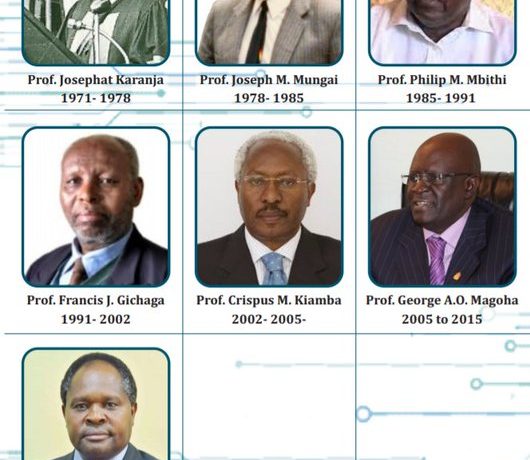
Prof. Crispus Kiamba, a former Vice Chancellor of the University of Nairobi who served from 2002 to 2005 was privileged to read the citation for the 8th Vice Chancellor of the University of Nairobi, Prof. Stephen Kiama.

Prof. Kiama has accumulated a vast wealth of administrative experience, honed his skills in management of people and programmes for set outputs, cut his teeth in leadership and distinguished himself as a capable leader stated Prof. Crispus Kiamba.

“May God accord you what you pray for, may the good Lord continue to expand your territories as you run the University as the 8th Vice Chancellor, wish you the very best and every God’s blessing” were the final words of Prof. Kiamba to the 8th VC.

Chancellor’s remarks during the 8th VC Installation Ceremony

The Chancellor Dr. Vijoo Rattansi in her speech during the installation of the 8th UoN VC on June 5, 2020 reminded the audience that historically, installation of a Vice Chancellor is an essentially significant and functionally symbolic rite of passage. In a University rich in tradition and heritage, installation is a symbolic rite of transition signifying succession at the helm of the university. It signifies that one leadership era has ended and ushers in a new one.

Dr. Rattansi indicated that she was privileged and indeed honoured to preside over the first installation event, of its kind, in the history of our nation. “Today, the COVID-19 pandemic has confounded us and presented unprecedented challenges, challenges that we must surmount for our own continued survival” she stated.

She thanked the university staff and students for according patience and respect to the Vice Chancellor recruitment, for steering clear of speculative discourse and for refraining from disinformation regarding the process. Over time, it has become evident that staff and student unions are not enemies of university leadership and that they, in fact, commend the top management when they do well. The Chancellor advised that the University’s management should lend a listening ear to staff and student grievances that may arise from time to time. Ultimately, they should all work towards the same goal that focuses on cultivating and bringing out the best in each other.

She indicated that the result of the recruitment process is a Vice Chancellor that best fits the bill for the current needs of the University. It is therefore expected that the new Vice Chancellor and the Deputy Vice Chancellors who serve under him will be bold enough to take tough decisions of reengineering University systems and processes and instituting meaningful reforms in critical areas of organizational structure, governance mechanisms, fiscal and resource management, curricula amongst others.

Dr. Rattansi prayed for wisdom and foresight for the 8th VC and assured him of her unqualified support

UoN Council Chair Remarks during the 8th VC Installation Ceremony

During the Installation ceremony of the 8th UoN Vice Chancellor held on June 5, 2020, the Council Chair Prof. Julia Ojiambo in her remarks stated that the council members were are greatly honoured to participate in the event installing the 8th Vice Chancellor of the University of Nairobi. The Council Chair congratulated the Vice Chancellor, Prof. Stephen Kiama Gitahi on the achievement and wished him well on his new duty.

She appealed to the Deputy Vice Chancellors and the management team to recognize that success is a collective enterprise. “In the Vice Chancellor’s success, we all succeed and, in his failure, we all fail. In this context therefore, I invite you to work together and support the Vice Chancellor in delivery of key reforms. The world is watching. Let us not fall short of their best expectations of us” stated Prof. Ojiambo.

She stated that the Chancellor had done her part to strengthen governance, the Council had done its part in formulating and documenting the blueprints that mark the path to our destination. The council now looks to the VC and his team to champion reengineering of University systems and processes and institute meaningful reforms in critical areas of organizational structure, governance mechanisms, fiscal and resource management, curricula.

The Council Chair called for patience, understanding and unqualified support from all members of the University and our stakeholders indicating they had a long road to travel together.


UoN admits Crème de la crème of the 2019 Graduates

The Cabinet Secretary, Education Prof. George Magoha on Tuesday June 2, 2020 revealed the placement report on the admission of the 2019 graduates to Universities and TVET Institutions.

From the report, it emerged that the University of Nairobi will admit 313 students who scored straight As out of the total 630 As. JKUAT will admit 117 students who scored A grade, KU 64, and Moi University 53, Egerton 26 and Technical University of Kenya 17.

On the other hand, JKUAT received the highest number of student’s placement at 6,006, UoN 5,894, Kenyatta University 5,659, Kisii University 5,566 and Moi University, 4,948.

The most competitive degree programs selected by the students include Medicine, Civil Engineering, Architecture, Pharmacy and Computer Science.

Congratulations to the students admitted to UoN. The University is putting plans in place to receive you despite the covid pandemic challenges being faced by the Education sector among other sectors.


Skills-gap challenge among graduates

Are companies getting the kind of graduates they need and are universities training graduates able to respond to development needs including achieving the vision 2030 agenda?

With the dynamic requirements by industry in terms of innovation and value proposition, there is need for creation of frameworks and building of capacity of students. Universities have to be willing to address requirements of industry and therefore, partnership is called for. The Industry must inform the requirements of research capacities by universities. Together with universities, industry need to create the right frameworks and structures to promote organized research. Technical vocational training is also vital. The Private sector has potential due to its diversity to support universities in addressing aspects of innovation through the implementation of the vision 2030 strategy and the Big 4 agenda.

It has been reported that the students universities are churning out lack soft skills. They do not know how to communicate both orally and verbally, lack a positive attitude, do not look presentable at interviews, are not willing to learn new things and cannot submit reports in time among other challenges reported by HR practitioners. In this 21st century, employers are now looking out for analytical, problem solvers and critical thinking individuals to hire.

Graduates are even having difficulties applying theories learnt in University. Some companies such as McKinsey have resolved to take their new employees through a two-year work exposure program and the employees turn out to perform really well. Some employers, however, are not able to retrain graduates who have gone through a four-year training for another two years because it is a lot of investment on time. Rockefeller Foundation for instance provides some stipend for internship training to enable graduates get a better understanding of what is required of them in the job market.

It was noted that candidates invited to interviews and internships fail particularly in exhibiting technical and soft skills. With the recent changes in technology with new areas emerging such as Blockchain Technology, Internet of Things (IOT) and Artificial Intelligence, there is dire need for graduates to have a grasp of these skills.

The world is changing and Universities must, therefore, change their approach. Unfortunately, most institutions of higher learning are still rigid and do not seem to accommodate changes around them. The field of Artificial Intelligence for instance requires new training for students to fit in most of the new jobs in the market.


Virtual Mentorship Induction conducted for mentorship champions

The Office of the Deputy Vice Chancellor, Students Affairs through the Senate Students Mentorship Committee led by Prof. Winfred Kamau (School of Law) on Tuesday June 3, 2020 conducted training for over 50 mentorship champions.

This training was organized to enable the mentorship champions be able to coordinate virtual mentorship activities for students during this Covid-19 pandemic. The mentorship champions are drawn from all Colleges, Campuses, DVC, SA, Office of Career Services and Dean of Students office.

This pandemic period has affected everyone including students bringing fear, anxiety, stress, uncertainty, limited resources, social distancing, home dysfunctions, education at home, changed priorities among other challenges and to help students cope with this, the University has planned virtual mentorship activities beginning June 2020. The virtual mentorship program is being supported by the UNESCO/UNITWIN Chair at the University of Nairobi.

Prof. C.B.K. Nzioka gave the opening remarks on behalf of the UNESCO/UNITWIN Chair, Prof. Judith Bahemuka. In his remarks, he indicated that the purpose of the training was to strengthen the capacity of the University in response to the covid-19 pandemic. The University has embraced online teaching and learning and this virtual mentorship will help students to cope with challenges brought about by the pandemic such as mental health.

Prof. Winnie Kamau from the School of Law who is the Chair of the Senate Students Mentorship Committee outlined the objectives of the training which include to help the mentorship champions understand the fundamentals of mentorship and appreciate the unique challenges to mentorship arising from the pandemic.

This training session was conducted by Pr. Simon Mbevi, the CEO, Transform Nations. Pr. Mbevi elaborated on the types of mentorship, the elements of great mentorship, today’s mentee needs, virtual mentorship challenges and mentorship benefits. For any mentorship process to be successful, three connection blocks that the mentor must practice include Acceptance (appreciating the mentee for who they are), Affection (mentor needs to show affection to the mentee) and Affirmation (mentor needs to affirm the strengths, potentials, values and effort of the mentee).

This session was very informative and educative to the mentorship champions and more trainings are planned in the following weeks to enable the team to possess the skills they need to implement the virtual mentorship program.